
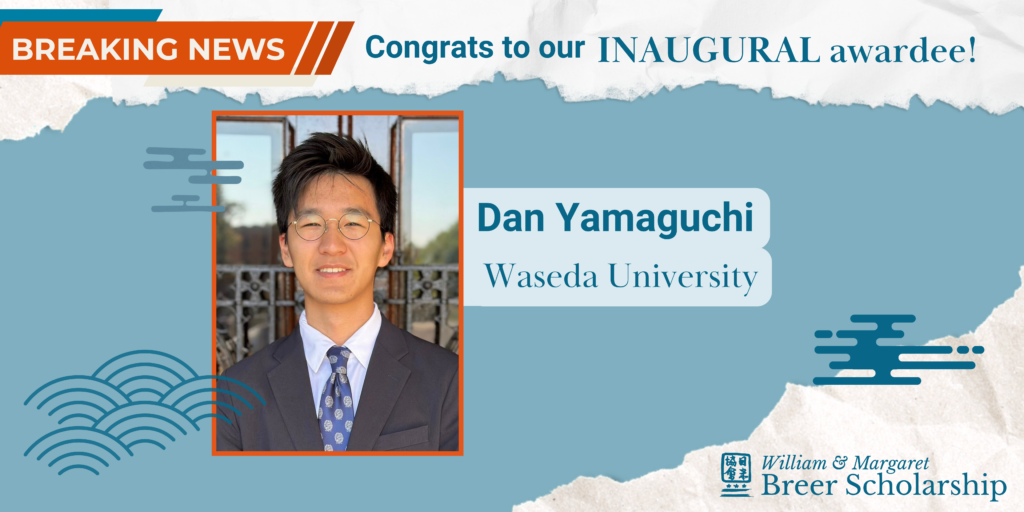
Congratulations to the inaugural awardee of the William & Margaret Breer Scholarship!
We are thrilled to announce the recipient of the William & Margaret Breer Scholarship for the 2026-2027 academic year:
🎓 Dan Yamaguchi from Georgetown University, studying for one year at Waseda University.
Applications for the 2027-2028 academic year will open in late spring/early summer of 2027. Please check back for future updates.
The William & Margaret Breer Scholarship will give up to $10,000 to one student studying for at least one academic year during the 2026-2027 school year. The scholarship may be used for any combination of tuition and other academic fees, room and board, travel and transportation (including travel within Japan), and other approved expenses.
Inquiries
Any questions regarding the William & Margaret Breer Scholarship should be submitted in writing to JASWDC at scholarships@jaswdc.org. Please do not call.
About the Breers
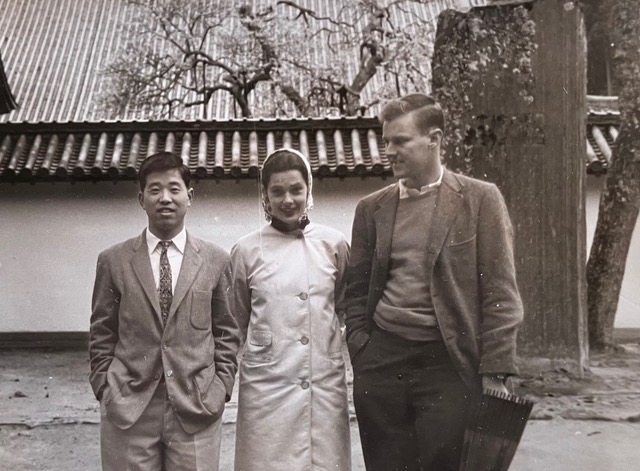
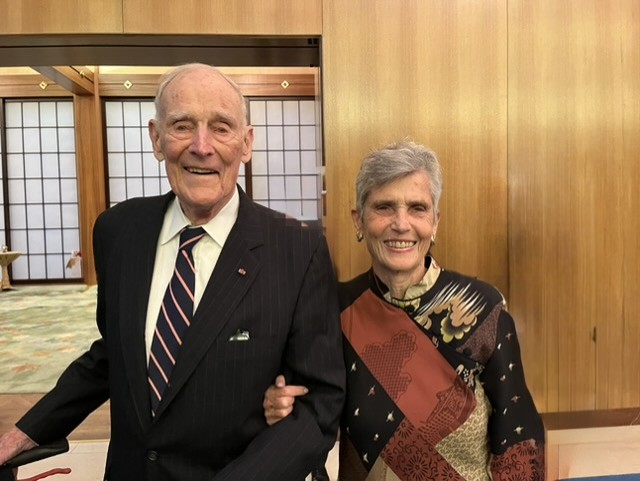
William “Bill” and Margaret “Peggy” each arrived in Japan in the fall of 1959 for what they thought would be a short period of adventure, tourism and exploration. Through a series of chance encounters and the kindness and generosity of Japanese friends, they were able to enthusiastically extend their visits and eventually found themselves seated next to each other at The Naganuma Japanese Language School in Shibuya. They ended up staying in Japan for a full academic year and made many friends with whom they remain in touch.
Read more
Bill took the Foreign Service written exam at the US Embassy in the spring of that year and passed it (Peggy didn’t even know what it was)! After returning to the US, Bill passed the oral exam when Peggy was working in New York City for Mitsui & Co. After Bill found out that his first Foreign Service assignment was Japan, he immediately proposed. They married in May of 1961 and honeymooned in Hawaii on their way to their first assignment at the US consulate in Yokohama. After the consulate closed, they moved to the US Embassy in Tokyo where Bill served in a number of positions. Eight years after arriving in Japan he was named Consul at the US Consulate in Sapporo after which they returned to the US with three Japanese speaking children in tow. They continued to move back and forth over a period of some 30 years serving in Japan for a total of 20 years. Bill’s final assignment was DCM in Tokyo and he retired from the Foreign Service in 1993. After retirement, he joined CSIS as Japan Chair, served as chairman of the board of JASWDC and joined the boards of the Mansfield Foundation and International Student Conference. In 2007, Bill was awarded the Order of the Rising Sun, Gold Rays with Neck Ribbon.
While Bill was busy at the work of diplomacy, Peggy was active with other endeavors. In addition to raising three young children , she continued to studyJapanese and build lifelong friendships which last to this day. During home assignments in Washington she earned a Masters in linguistics and Japanese language from Georgetown University. She also attended a summer program at Cornell University for Teaching Japanese as a Foreign Language (the counterpart to ESL) During later assignments in Tokyo she joined the faculty of a school that trained simultaneous interpreters where she taught the techniques of translating written Japanese to English. She also opened the Tokyo branch of Inlingua School of languages and was a teacher there.. After returning to Washington in 1993, Peggy’s main focus was Japan Bowl. It had started in 1992 as a small competition which was the brainchild of JASWDC. In the beginning, about 5 or 6 local schools participated and answered approximately 30 questions. After senbei and drinks, Kenkyusha dictionaries were awarded to the winning team and everyone went home. Quite a different scene from today! Peggy served on the Japan Bowl Council for over 30 years and is proud of the way this competition grew to the nation-wide competition we know today.
As a couple, Bill and Peggy look back on their time as students in Japan and how those early experiences set them on a course of dedication to furthering Japan-American relations. They remain eternally grateful for everything that Japan made possible for them and of course their many wonderful Japanese friends.
Applications for the 2026-2027 academic year are CLOSED.
Applications for the 2027-2028 academic year will open in 2027.
Requirements for Applicants
- Must be enrolled full-time in an undergraduate or graduate school in the United States.
- Must provide proof of acceptance at a college or university in Japan as a full-time foreign exchange student for at least one academic year.
- Must provide proof that the program in Japan is an approved student exchange program of the applicant’s home college or university in the US.
- Must intend to return to the college or university in the United States.
- May be majors in any subject, but must demonstrate that they have taken or plan to take academic courses related to Japan, whether in the US or at the college or university in Japan.
- Must be a citizen or permanent resident of the United States
Application Procedure for 2026 – 2027
Applicants should submit the online application form before the deadline of Friday, July 31st, 2026, at 11:59 PM EDT. All applicants will be requested to submit the following supplemental documents through the online application form:
- School transcripts from the past academic year.
- (A) Proof of acceptance at a college or university in Japan and (B) certification that the proposed academic study is an official student exchange program of the applicant’s home college or university. This can be a letter or notice from either the home institution or the Japanese college or university.
- One letter of recommendation from a professor or academic advisor.
- A 1-page essay (Times New Roman, 12pt font, double-spaced, 1″ margins) telling us about your connection to Japan – past, present, and future. You may want to consider the following when writing your essay:
- Why did you become interested in Japan?
- How have you pursued your interest in Japan, both inside and outside the classroom?
- Tell us about your study of Japan’s language, culture, history, and society.
- What Japan-related courses have you taken in college/university, and how did they affect you?
- What do you plan to study during your time in Japan, and how do you think that will benefit your plans for the future?
- What kind of “Japan connection” do you hope to establish for yourself in the future, after you receive your degree?
You do not need to submit these documents separately from your application. Failure to submit all required documents or to fully complete the application will render the applicant ineligible. JASWDC will not follow up if an application is incomplete.
Priorities and Preferences for Reviewing and Screening Applications
In reviewing applications, the JASWDC Scholarship Committee will give priority and preference to applicants who can demonstrate a combination of any of the following factors:
- Are legal residents of the District of Columbia, Maryland, or Virginia (i.e., you may be studying at a college or university anywhere in the US, but your home/parents’ home is in DC, MD, VA)
- Are members or are children of members of the Japan-America Society of Washington DC
- Have interned with the Japan-America Society of Washington DC
- Have volunteered with the Japan-America Society of Washington DC
- Have participated in the National Japan Bowl®
- Have studied and/or are currently studying the Japanese language
- Have studied and/or are currently taking academic courses on Japanese history, culture, society, politics, arts, literature, etc.
- Have participated in extra-curricular activities related to Japan outside the academic classroom (for example, ikebana, tea ceremony, or Japanese cooking lessons; Japanese martial arts; Japan culture clubs, etc.)
Selection and Announcement
The Scholarship Committee will review all applications in accordance with the requirements, priorities, and preferences listed above.
JASWDC will inform the scholarship awardee by Friday, August 28th, 2026.
Program Reporting
The recipient of the William & Margaret Breer Scholarship is required to submit two reports.
Following completion of the first term (semester) of study, the applicant is required to submit a mid-term report that describes the student’s experience in Japan, both academic and non-academic, how that experience has affected their thinking and knowledge about Japan, and what the applicant hopes to achieve in the remainder of the academic term.
Following completion of the second term (semester) of study, the scholarship recipient is required to submit a report that reflects on their experience since the initial report, and describes how their overall experience during the scholarship will fit into plans for the future.
Each report shall be either written format (1-2 pages) or video format (2 to 5 minutes), along with photos from their time in Japan.
Full report guidelines available here.
Scholarship Payment
Payment will be made in two allotments. An initial payment of up to $5,000 will be made before the academic study in Japan commences (or within 30 days after the awardees are notified). A second payment of $5,000 will be made after the mid-term report has been received by JASWDC. A final report, upon completion of the academic year of study, will be required as a condition of successful scholarship completion.
Inquiries
Any questions about the William & Margaret Breer Scholarship Program should be submitted in writing to JASWDC at scholarships@jaswdc.org. Please do not call.